Navigating the AI Shift: The Future of Offshore IT Outsourcing in India
For decades, the offshore outsourcing model—with India as its undisputed epicenter—has been the engine room of global software development. Driven by a massive talent pool, cost arbitrage, and a favorable time-zone overlap for continuous development, India’s IT sector became a multi-billion-dollar behemoth.
However, the rapid ascent of Generative AI and advanced coding assistants (like GitHub Copilot, Gemini Code Assist, and autonomous agents) has triggered a fundamental question for technical leaders: Will AI replace the need to offshore development entirely?
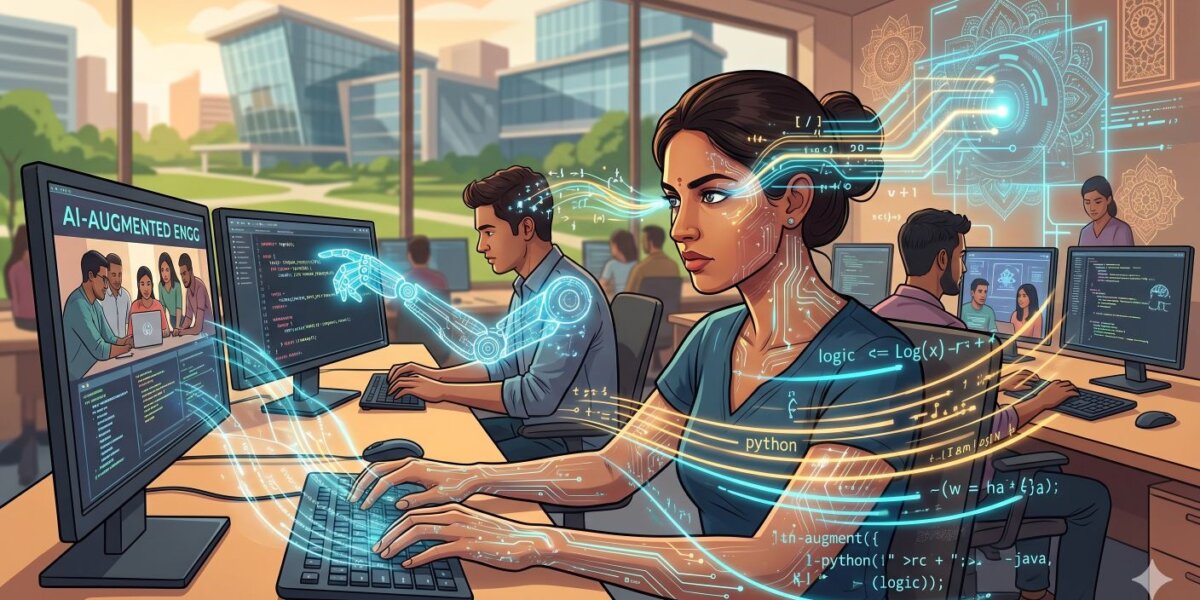
The reality is neither a complete replacement nor business as usual. AI is forcing a violent evolution in the offshore model. The days of “body shopping”—throwing hundreds of junior developers at a project to write boilerplate code or perform manual testing—are coming to an end. Instead, we are entering an era of AI-augmented engineering.
To navigate this transition, technology leaders must understand the timeline of AI’s impact on the Indian IT sector and, crucially, how to choose the right development model for their current needs.
Timelines of Impact: The Evolution of Offshore Development
The disruption of the traditional offshore model is not a single event; it is a phased evolution. Here is a realistic timeline of how AI will reshape outsourced development in India.
Phase 1: The Augmentation Era (Present to 2028)
We are currently in this phase. AI is not replacing development teams; it is supercharging them. Indian IT firms are aggressively integrating AI coding assistants to boost developer productivity by 20% to 40%.
- The Impact: Routine tasks like writing boilerplate code, generating unit tests, and basic debugging are largely automated.
- The Shift: Pricing models are beginning to crack. The traditional “Time and Materials” (billing by the hour/headcount) model is facing pressure as clients realize tasks take less time. We are seeing a gradual shift toward outcome-based or fixed-price billing. Junior-level hiring in Indian IT services is slowing down, while demand for prompt engineers and AI integrators is spiking.
Phase 2: Consolidation and Structural Shift (2028 – 2031)
As Agentic AI—systems capable of planning, reasoning, and executing complex multi-step workflows—matures, the structure of offshore teams will shrink and change.
- The Impact: AI will handle mid-level development tasks, complex refactoring, and automated QA pipelines with minimal human intervention.
- The Shift: A project that previously required a team of 50 offshore developers might only need 15 “AI Orchestrators” and senior architects. India’s IT sector will pivot from writing raw code to managing, governing, and securing enterprise AI deployments. The value proposition will shift from pure cost savings to high-velocity, AI-driven problem-solving.
Phase 3: The Autonomous Era (2032 and Beyond)
In the long term, natural language will become the primary programming interface for many business applications.
- The Impact: Non-technical product managers will be able to generate functional software using advanced AI platforms.
- The Shift: Offshore partners in India will transition into highly specialized consulting hubs. They will manage the infrastructure that runs these massive AI models, ensure data privacy compliance, integrate complex legacy systems with autonomous agents, and provide the deep, human architectural oversight that AI still lacks.
The Decision Framework: Which Model Should You Choose?
As the landscape shifts, technical leaders are faced with three primary operating models. Here is a guide on when to deploy each strategy.
1. Pure In-House + AI (The Lean Model)
This model relies on a small, highly skilled internal team leveraging powerful AI tools to do the work of a much larger group, keeping everything onshore and in-house.
- When to choose this:
- Early-Stage Startups & MVPs: When you need to pivot constantly, the tight feedback loop of an internal team is vital. AI allows a small team of three to output the work of ten, saving capital while retaining agility.
- Hyper-Secure/Proprietary Tech: If you are building core intellectual property, defense tech, or handling highly sensitive data where off-site data sharing (even with an agency) poses a security or regulatory risk.
- Complex Context: When the business logic is so uniquely intertwined with your company culture or highly niche industry that explaining it to an offshore team (or an AI) takes longer than building it.
2. Traditional Offshore Outsourcing (The Legacy Model)
This is the classic model: hiring an external team in India primarily for cost arbitrage, scaling up headcount to manage large workloads.
- When to choose this:
- Legacy System Migration: AI struggles heavily with poorly documented, decades-old codebases (like ancient COBOL or highly customized on-premise ERPs). You still need human developers to manually untangle, document, and migrate these systems before AI can be useful.
- Hardware-Dependent Testing: If your software requires extensive physical device testing, manual IoT integration, or localized network testing that cannot be simulated perfectly by software.
- Maintenance of Sunsetting Products: When you have a cash-cow product that requires basic bug fixes and support, but you do not want to invest your core onshore team or expensive AI resources into it.
3. AI-Augmented Offshore (The Modern Standard)
This is the new sweet spot. It involves partnering with forward-thinking Indian IT vendors who mandate the use of AI tools within their workflows and pass the efficiency and cost savings on to you.
- When to choose this:
- Scaling Enterprise Applications: When you need to build robust, scalable applications quickly. An AI-augmented offshore team will deliver enterprise-grade code much faster than a traditional team, providing the best return on investment.
- Standard Web and Mobile Development: For standard SaaS platforms, e-commerce builds, and mobile apps, the underlying architecture is well understood by AI. An offshore team using AI can assemble and customize these platforms with incredible speed.
- Data Engineering & AI Implementation: Ironically, the best use of this model is building your own AI capabilities. Indian IT firms are rapidly upskilling in data pipelines, LLM fine-tuning, and RAG (Retrieval-Augmented Generation) architectures. You can leverage their specialized AI talent at a lower cost than hiring onshore AI researchers.
The Bottom Line
AI is not the death of the Indian offshore model; it is the catalyst for its next iteration. India will remain a global IT powerhouse, but the currency is shifting from human effort to human oversight of machine effort. For companies looking to build software, the most successful strategy in the coming decade will not be choosing between AI and offshore talent, but finding the partners who best combine the two.