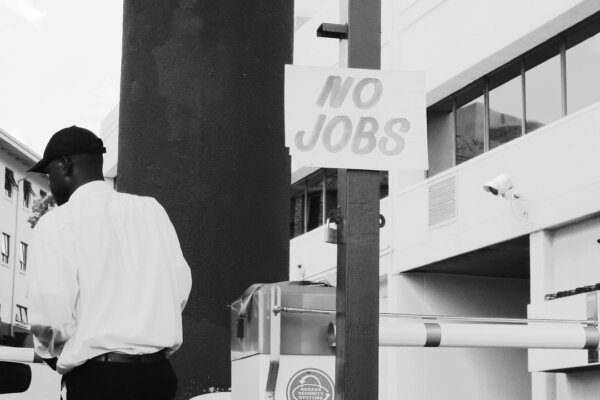
Photo by Fer Troulik on Unsplash
In an era defined by rapid technological advancement, the discourse around automation and artificial intelligence often oscillates between utopian visions of leisure and dystopian fears of mass unemployment. But what if the transition wasn’t gradual? What if, in a single, cataclysmic 24-hour period, a technological singularity or an unforeseen confluence of AI breakthroughs led to an instantaneous, global job purge, shaking the very foundations of our economic and social structures? This isn’t a prediction, but a thought experiment – a stark look at how such an event, however unlikely, could unravel our interconnected world.
The Automation Avalanche: Factory Floors and Service Desks Silenced
Picture this: a Monday morning dawns, and across the globe, millions of workers find their roles obsolete. In the manufacturing sector, advanced robotics, suddenly capable of unprecedented dexterity and cognitive reasoning, take over entire assembly lines, from intricate electronics production to heavy machinery fabrication. Human hands, once indispensable, are now redundant. This isn’t just about simple, repetitive tasks; we’re talking about sophisticated robots managing complex logistics, quality control, and even adaptive manufacturing processes. Simultaneously, in the vast service sector, sophisticated AI agents, having achieved near-perfect natural language processing and emotional intelligence, replace customer service representatives, telemarketers, and even many administrative assistants. Call centers, once bustling hubs of human interaction, fall silent. The sheer speed of this hypothetical shift – a mere 24 hours – would leave no time for adaptation, no opportunity for reskilling. The immediate economic shock would be profound, as consumer spending, driven by wages, would plummet.
Tech Titans and the White-Collar Reckoning
Even the seemingly impenetrable bastions of the tech world and professional services wouldn’t be immune. Imagine AI algorithms suddenly capable of generating flawless code, designing intricate user interfaces, or performing complex data analysis with superhuman speed and accuracy. Software developers, data scientists, and even some creative professionals could find their expertise outmatched by systems that learn and adapt at an exponential rate. Legal research, basic accounting, and even aspects of medical diagnostics could be fully automated. The C-suite might find their strategic decisions informed, or even dictated, by predictive AI models far superior to human intuition. This isn’t just about blue-collar jobs; it’s a wholesale re-evaluation of what constitutes “value” in a rapidly evolving, technologically advanced economy. The psychological impact on individuals, suddenly stripped of their professional identity and purpose, would be immense and far-reaching.
The Global Economic Tsunami and Social Fallout
The immediate aftermath of such a purge would be nothing short of a global economic tsunami. With millions unemployed simultaneously, consumer demand would evaporate. Supply chains, designed for human-driven consumption, would seize up. Financial markets would crash as investor confidence plummeted and companies faced a workforce crisis of unprecedented scale – not a shortage, but an extreme surplus. Governments, caught entirely off guard, would grapple with an impossible challenge: how to support a suddenly massive, jobless population? Social unrest would inevitably follow, fueled by desperation and a sense of betrayal by the very technologies once heralded as progress. The very concept of work, a cornerstone of human society for millennia, would be fundamentally challenged. The ripple effects would touch every corner of the globe, from trade relationships to international aid, creating a crisis unlike any seen in modern history.
Preparing for the Future: A Call to Proactive Adaptation
While the “24-hour job purge” is a dramatic hypothetical, it serves as a powerful reminder of the accelerating pace of technological change and its potential to reshape our economic landscape. The real world’s transition will likely be more gradual, but the underlying pressures remain. To mitigate future disruption, we must proactively invest in education and reskilling programs that foster uniquely human skills – creativity, critical thinking, emotional intelligence, and complex problem-solving – that are harder for AI to replicate. We need to rethink social safety nets, explore concepts like Universal Basic Income (UBI), and foster a culture of lifelong learning. Engaging in open, honest dialogue about the ethical implications of AI and automation, and developing robust policy frameworks, is not just advisable, but essential. The future of work may not arrive in a single day, but the decisions we make today will determine our readiness for tomorrow’s technological transformations. Let’s ensure humanity remains at the heart of progress.