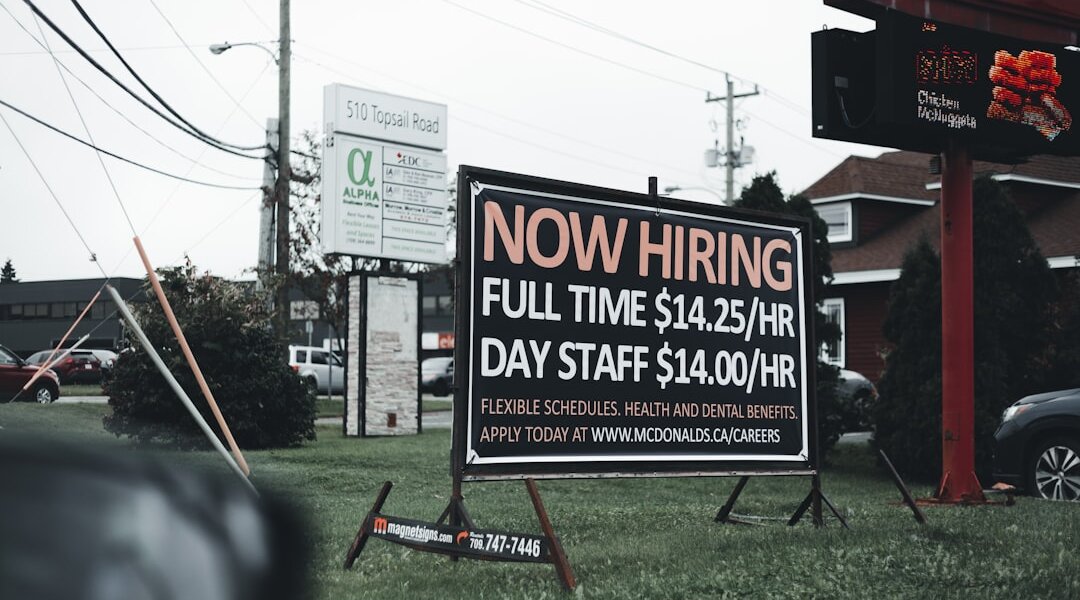
Photo by Erik Mclean on Unsplash
The global workforce is currently navigating a turbulent period, marked by significant job reductions across sectors once considered pillars of stability. What began as a concentrated wave in the technology industry has now expanded, sending “red alerts” through manufacturing and services, raising questions about whether we are witnessing the dawn of a fundamentally new economic reality. The numbers speak for themselves: over 1 million workers lost their jobs to layoffs across nearly every major industry by the end of October 2025, with forecasts suggesting 2026 will bring more of the same.
This isn’t merely a cyclical downturn; it’s a complex interplay of macroeconomic forces, technological advancements, and shifting corporate priorities that are reshaping the very fabric of employment. As companies grapple with economic uncertainty, rising costs, and the rapid integration of artificial intelligence, a profound transformation of the labor market is underway.
The Unfolding Crisis: Beyond Tech’s Bubble
While tech layoffs often grab headlines, the current wave of job cuts extends far beyond Silicon Valley. In 2025, approximately 127,000 workers were laid off from U.S.-based tech companies. However, 2026 has seen a renewed surge, with over 100,000 tech jobs already cut worldwide by early May. Major players like Microsoft, Amazon, Meta, and Oracle have announced significant reductions, often while simultaneously hiring in AI-related roles, signaling a strategic reallocation of talent rather than a blanket hiring freeze.
The manufacturing sector is also facing substantial pressure. Companies like Intel, for instance, slashed 24,000 roles, or 20% of its workforce, shifting focus from production to design. Ford announced layoffs of all 1,600 employees at a Kentucky battery plant as it pivots away from EV battery production. Even food manufacturing, automotive, and logistics are seeing significant job losses, driven by supply chain efficiencies and automation. The services sector, encompassing retail, finance, and even government contractors, is not immune, with major firms like Morgan Stanley and Standard Chartered announcing thousands of cuts.
Drivers of the Downturn: Economic Headwinds and AI’s Ascent
Several intertwined factors are fueling this widespread workforce disruption:
- Economic Uncertainty and Cost of Capital: Economic uncertainty was the primary driver for 55% of companies conducting layoffs in 2025, with tariff and trade policy concerns also playing a significant role. Higher interest rates have made capital more expensive, forcing companies to prioritize profitability and efficiency over aggressive expansion. This shift is particularly pronounced in high-growth companies.
- Post-Pandemic Correction: Many companies, especially in tech, overhired during the pandemic boom, anticipating sustained digital growth. As economic conditions normalized, these inflated payrolls became unsustainable, leading to significant corrections.
- The AI Revolution: Artificial Intelligence is a rapidly accelerating force reshaping the job market. While not always the sole cause, AI adoption is a growing driver for job cuts, cited by 35% of businesses planning layoffs in 2026. Companies are explicitly linking layoffs to increased investment in AI infrastructure, with some firms like Cloudflare seeing a 600% increase in AI tool usage in just three months, leading to workforce reductions. AI is automating routine tasks, allowing companies to achieve higher productivity with fewer employees. Goldman Sachs Research estimates that 300 million jobs globally are exposed to automation by AI.
Navigating the New Landscape: Resilience and Reinvention
The current environment suggests a structural shift rather than a temporary blip. Workers in highly exposed professions are more likely to be older, female, more educated, and higher-paid. High-salary workers are often targeted first for layoffs due to immediate payroll savings, followed by those lacking AI-related skills.
This “new economic reality” demands resilience and continuous reinvention. For individuals, investing in AI literacy and building skills that resist automation are paramount. Specialized skills and knowledge will be in higher demand as AI becomes more ubiquitous. For instance, workers with multiple AI skills can command a salary premium of around 43%. New roles are emerging in AI development, data analytics, and human-AI collaboration, requiring professionals to embrace technological fluency and problem-solving abilities.
Businesses, too, must adapt by strategically implementing AI, focusing on upskilling their existing workforce, and reallocating resources toward new technologies and business models. The shift towards efficiency and productivity is permanent.
Conclusion: The Future of Work is Now
The widespread layoffs across tech, manufacturing, and services are a stark indicator of a transforming global economy. Driven by economic uncertainty, post-pandemic adjustments, and the accelerating impact of AI, this period is redefining the nature of work. While challenging, it also presents an opportunity for growth and innovation. The future workforce will be one that is agile, continuously learning, and adept at collaborating with advanced technologies. It’s time to assess your skills, embrace continuous learning, and prepare for a job market that values adaptability and AI proficiency.
What steps are you taking to adapt to this evolving economic landscape? Share your thoughts and strategies in the comments below!