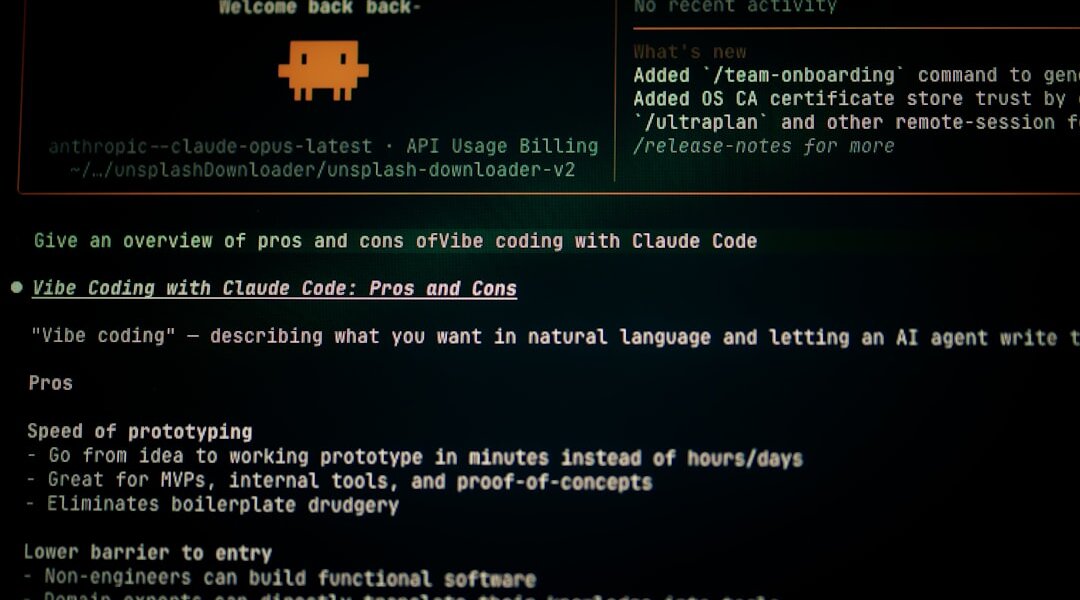
Photo by Bernd 📷 Dittrich on Unsplash
In a move that sends ripples across the technology landscape, Snap Inc., the parent company of Snapchat, has announced a substantial 16% reduction in its workforce. While layoffs are unfortunately not uncommon in the fast-evolving tech sector, Snap CEO Evan Spiegel’s reasoning for this particular restructuring has captured significant attention: increased efficiency driven by artificial intelligence. According to Spiegel, AI now astonishingly generates 65% of the company’s new code, marking a pivotal moment in the integration of AI into core development processes.
This bold claim not only highlights the rapid advancements in AI’s capabilities but also ignites crucial conversations about the evolving roles of human developers, the future of productivity, and the potential for AI to fundamentally reshape the tech industry’s employment landscape. Is Snap an outlier, or is this a clear signal of what’s to come?
The AI-Driven Productivity Surge at Snap
Snap’s declaration isn’t just about reducing headcount; it’s a testament to a deliberate, long-term strategy of leveraging AI to supercharge its engineering efforts. The figure of 65% AI-generated new code is remarkably high, suggesting a deep integration of generative AI tools and intelligent automation into every stage of their software development lifecycle. This likely includes AI assistants for boilerplate code, unit test generation, bug detection, and even suggesting architectural patterns.
For Snap, this isn’t merely about cost-cutting; it’s about agility and innovation. By offloading a significant portion of the routine and repetitive coding tasks to AI, human engineers can theoretically focus on higher-value activities: complex problem-solving, architectural design, ethical considerations, prompt engineering for AI tools, and pushing the boundaries of user experience. This pivot aims to accelerate product development cycles, reduce time-to-market, and potentially free up resources for entirely new ventures within the company.
Beyond Snap: A Harbinger for the Tech Industry?
Snap’s situation serves as a potent case study that the broader tech industry cannot ignore. While many companies have been experimenting with AI-powered development tools like GitHub Copilot, Amazon CodeWhisperer, and various in-house solutions, few have publicly attributed such a direct and significant link between AI efficiency and workforce restructuring. The 65% figure sets a new benchmark and will undoubtedly prompt other tech leaders to scrutinize their own AI adoption strategies.
This trend suggests a future where software development teams might operate with a leaner structure, composed of highly skilled engineers who are proficient in collaborating with AI. The emphasis shifts from writing every line of code manually to effectively ‘managing’ and ‘guiding’ AI models to generate optimal solutions. Companies that fail to adapt their workflows and reskill their teams risk being left behind in terms of productivity and innovation.
Navigating the New Landscape: Upskilling and Adaptation for Developers
For individual software developers and engineers, Snap’s announcement underscores an urgent need for adaptation. The skills most valued in an AI-augmented development environment are evolving rapidly. Instead of fearing replacement, developers are encouraged to:
- Master AI-Assisted Tools: Proficiency in using generative AI for coding, debugging, and testing will become fundamental.
- Focus on Prompt Engineering: The ability to articulate precise, effective prompts to AI models will be crucial for generating high-quality code.
- Emphasize System Design and Architecture: AI can write code, but humans are still best at designing robust, scalable, and secure systems.
- Specialize in Complex Problem Solving: Tackling unique challenges, handling edge cases, and innovating beyond standard solutions will remain human domains.
- Embrace Ethical AI and Oversight: Understanding AI’s limitations, biases, and ensuring responsible implementation will be vital.
The future of work for developers isn’t about becoming obsolete, but about evolving into an AI-enhanced role, focusing on higher-order thinking and strategic contributions that leverage AI’s capabilities rather than competing with them.
The Future is Now: Collaborate, Adapt, Thrive
Snap’s significant staff reduction, directly linked to unprecedented AI efficiency in code generation, is a stark indicator of the transformative power of artificial intelligence on the tech industry. It challenges traditional notions of productivity and spotlights the dramatic shifts occurring in software development. While such news can be unsettling for the workforce, it also presents a powerful opportunity for growth and redefinition.
For companies, it’s a call to strategically integrate AI to drive innovation and efficiency. For individuals, it’s a powerful reminder to continuously upskill and adapt, ensuring readiness for a future where collaboration with intelligent machines isn’t just an option, but a core competency. The era of AI-generated code is here, and those who learn to harness it effectively will define the next chapter of technological advancement.
What are your thoughts on Snap’s move? How do you think AI will continue to reshape the tech industry and the role of developers? Share your insights in the comments below!